

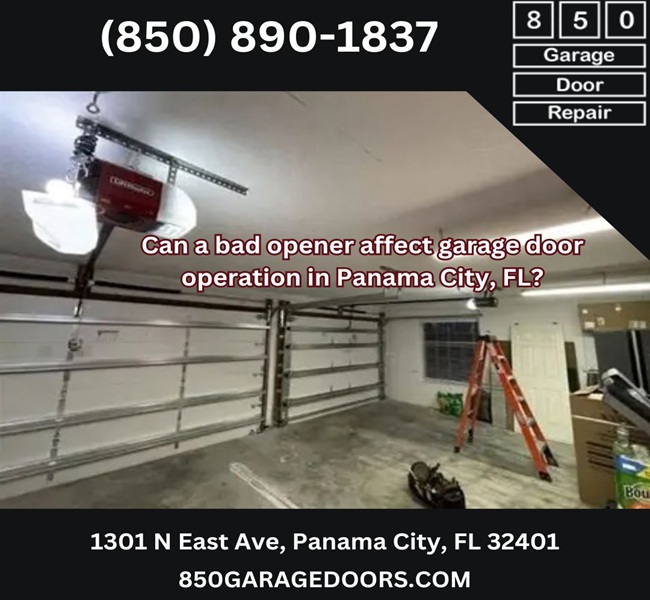
Yes, a bad garage door opener can absolutely affect garage door operation, and in many cases it is the root cause of problems that homeowners mistakenly blame on other components. When an opener begins to fail, it does not just stop working on its own. It places abnormal stress on every part connected to it, including the springs, rollers, tracks, and door panels. For homeowners in Panama City, FL, where coastal humidity and salt air already put mechanical systems under constant strain, a struggling opener can accelerate damage across the entire system faster than it would in a drier inland climate. Understanding what is happening and why it matters can save you from a much larger garage door repair down the road.
How a Failing Opener Disrupts the Entire Garage Door System
The Opener's Role in Coordinated Door Movement
A garage door opener does more than simply pull a door up and down. It controls the speed, force, direction, and stopping points of a heavy moving system that can weigh anywhere from 150 to 400 pounds depending on the door type. The opener communicates with sensors, limit switches, and drive components to ensure the door moves in a smooth, balanced cycle each time it is activated.
When any part of that coordination breaks down, the door no longer operates as a unified system. Instead, individual components absorb stress they were never designed to handle alone. A motor that hesitates, surges, or applies inconsistent force is essentially sending the wrong instructions to every connected part, and those parts respond by wearing out faster than normal.
What Happens When Opener Force and Speed Settings Are Off
Modern Garage Door Openers have built-in force and travel limit settings that calibrate how hard the motor pushes and exactly where the door stops at the top and bottom of its travel. When these settings drift out of calibration, or when the motor itself begins to lose power, the door is either pushed too hard, not pushed hard enough, or stopped at the wrong point in the cycle.
Uneven Travel That Strains Tracks and Rollers
When the opener applies uneven force during travel, the door shifts slightly side to side within the track system. Over time, this creates friction points where the rollers press against the track wall rather than rolling smoothly through it. The result is premature roller wear, track bending, and in some cases, a door that visibly shakes or rattles during operation. What looks like a roller or track problem often originates with the opener.
Inconsistent Stopping That Wears Down Springs
The springs on a garage door are calibrated to counterbalance the door's weight at specific points in its travel. When an opener with faulty limit settings forces the door past those calibration points, or stops it short repeatedly, the springs are forced to hold or release tension at moments they were not designed for. This adds hundreds of unnecessary stress cycles over time, shortening the lifespan of springs that are already under significant mechanical load.
Warning Signs Your Opener Is Damaging Your Door
The Door Reverses, Hesitates, or Stalls Mid-Cycle
One of the earliest and most recognizable signs of an opener problem is a door that starts to open or close and then suddenly reverses or stops without completing the cycle. Most homeowners assume this means something is blocking the safety sensor beam. But when there is no visible obstruction, the cause is frequently a motor that is losing torque, a logic board sending faulty signals, or force settings that have drifted to a point where the opener reads normal travel resistance as an obstacle.
Each time this reversal cycle happens, the springs and drive components absorb a jolt of reversed force. It may seem minor in the moment, but repeated reversal cycles compound mechanical wear significantly over weeks and months.
Grinding or Straining Sounds During Operation
A healthy opener runs with a relatively consistent hum. When you begin hearing grinding, straining, or a labored motor sound, the opener is working harder than it should to move the door. This extra effort indicates either that the drive mechanism itself is worn, or that the door has developed resistance somewhere in the system that the opener is trying to overpower rather than correct for.
In either case, allowing the opener to continue straining compounds the problem. A motor that constantly overexerts itself generates heat, wears internal gears faster, and can cause sudden failure at the worst possible time, such as when a vehicle is inside or partially underneath the door.
The Door Appears Off-Track or Opens Unevenly
If you notice one side of the door moving faster than the other, or if the door appears tilted during travel, the opener may be pulling from a point of mechanical imbalance. This is particularly common in older belt or chain drive systems where the drive trolley has worn or the attachment point to the door bracket has loosened. The visual result looks like a track or spring problem, but correcting those components without addressing the opener will not resolve the underlying cause.
Why Panama City's Coastal Climate Accelerates Opener Failure
How Salt Air Corrodes Opener Components and Wiring
Panama City sits directly on the Gulf Coast, and the salt content in the coastal air is measurably higher than what garage door systems are typically rated to handle over a standard service life. Salt particles settle on every exposed surface, including the metal gears inside the opener head, the wiring connections at the motor terminals, and the circuit board components that control logic functions.
Corrosion at these points does not cause an immediate failure. It creates gradual resistance and intermittent faults that are difficult to diagnose because they come and go depending on temperature and humidity levels. Homeowners in Panama City frequently deal with opener behavior that seems random or seasonal, when in reality it is corrosion creating unreliable electrical connections that get worse during high humidity months.
Humidity's Effect on Motor Housing and Drive Systems
Beyond salt, the sustained high humidity along the Emerald Coast introduces moisture into opener motor housings and drive systems. Moisture thickens lubricants and causes them to break down faster, which increases friction in chain, belt, and screw drive systems. A drive system running on degraded lubrication forces the motor to work harder on every cycle, which accelerates both motor wear and the wear on the drive components it connects to.
Homeowners who do not have their opener serviced annually in a coastal Florida environment are operating a system that is accumulating hidden damage with every use.
| Opener Problem | Component Most Affected |
|---|---|
| Inconsistent force output from a worn motor | Garage door springs and torsion hardware |
| Faulty limit switch or travel calibration | Rollers, tracks, and bottom door seal |
| Salt air corrosion on wiring and logic board | Opener motor and safety sensor circuit |
| Degraded drive system lubrication from humidity | Chain, belt, or screw drive and motor load |
| Repeated mid-cycle reversal from false obstruction reads | Door panels, hinges, and bracket connections |
The Cascade Effect: One Bad Opener Can Damage Multiple Components
Springs Under Abnormal Load from a Struggling Motor
A garage door spring is a precision mechanical component with a finite cycle life. Under normal operating conditions with a properly calibrated opener, springs reach the end of their service life predictably. But when an opener applies erratic force or incorrect stopping points, the springs absorb compensating loads they were never intended to handle. This shortens their service life considerably and increases the risk of a sudden spring break. Scheduling Broken Garage Door Spring Repair promptly can prevent the door from becoming inoperable and in some cases dangerous.
Roller and Track Damage Caused by Misaligned Force
Rollers are designed to travel in a straight, consistent path through the vertical and horizontal sections of the track. When an opener pulls the door unevenly, the rollers are dragged along the track edges rather than rolling freely through the center. This wears the roller stems, cracks the roller wheels, and can cause small bends in the track that progressively get worse. A bent track section that starts from opener-related misalignment often requires professional Garage Door Rollers Repair and can become a full track replacement if not corrected early.
Door Panel Stress from Repeated Hard Stops
Every time a garage door slams into the floor or jerks to a stop at the top of travel because the opener's limits are off, the force of that stop is distributed through the door panels and the hinge connections between them. Garage door panels are not built to absorb impact forces. Over time, repeated hard stops crack panel corners, loosen hinge bolts, and cause the sections to lose their tight fit. What starts as an opener calibration issue becomes visible structural damage on the door itself.
Is It Safe to Keep Using a Garage Door with a Bad Opener?
When a Malfunctioning Opener Becomes a Safety Hazard
A garage door is the largest and heaviest moving object in most homes. When the opener managing that weight begins to malfunction, the risk of an uncontrolled movement increases. Auto-reverse safety functions depend on the opener reading force and obstruction signals correctly. A failing logic board or corroded sensor circuit may not trigger the reversal response when it should, which creates a genuine safety risk for people, pets, and vehicles in the door's path.
Beyond the reversal function, an opener that is forcing a door through a cycle despite mechanical resistance is capable of causing sudden spring failure or a door that comes off its tracks while in motion. Neither of these events gives warning ahead of time. This is why continuing to use a door with a known opener problem is not a calculated risk worth taking.
Signs the Problem Has Already Moved Beyond the Opener
If you are already noticing visible roller wear, track bends, unusual spring tension, or door panels that appear stressed or cracked, the opener malfunction has likely been underway long enough to cause secondary damage. At that point, repairing only the opener will not fully restore safe and reliable operation. A complete system inspection is the only way to understand the full scope of what the failing opener has affected.
Professional Opener Diagnosis and Repair in Panama City, FL
Why DIY Force Adjustments Often Make the Problem Worse
Many opener manuals include instructions for adjusting force and travel limit settings, and homeowners often attempt these adjustments when a door starts behaving erratically. The problem is that these adjustments address symptoms, not causes. If the motor is losing torque due to worn brushes or a failing capacitor, increasing the force setting only forces a weakened motor to work harder. If the drive system has mechanical wear, adjusting limits does not correct the underlying friction. In most cases, DIY adjustments delay a proper diagnosis and give the underlying problem more time to cause additional damage elsewhere in the system.
What a Trained Technician Checks During an Opener Inspection
A qualified garage door technician evaluates the opener as part of the complete system, not in isolation. The inspection includes measuring the actual force output of the motor against the door's balanced resistance, checking limit switch accuracy at the top and bottom of travel, testing the auto-reverse function against the safety standard, inspecting drive system components for wear and lubrication condition, examining wiring and circuit board connections for corrosion damage, and assessing whether any secondary components have been affected by how the opener has been operating.
In a coastal Florida environment like Panama City, technicians also look specifically for salt and moisture-related corrosion at every electrical connection point, because these are the failure modes most commonly accelerated by the local climate.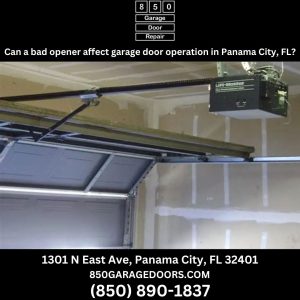
Conclusion
A bad garage door opener does not just affect the opener itself. It creates a chain reaction of stress and wear across every component in the system, from the springs and rollers to the tracks, panels, and safety functions that protect your household. In Panama City, FL, where salt air and humidity already put mechanical systems under continuous environmental pressure, a struggling opener causes damage faster and more extensively than most homeowners realize until the problem becomes impossible to ignore.
To come back to the original question: yes, a failing opener absolutely affects garage door operation, and the longer it goes without attention, the more costly and complex the repair becomes. If your door is showing any of the warning signs covered here, the team at 850 Garage Doors is ready to help. Serving Panama City and the surrounding area, 850 Garage Doors provides thorough opener inspections, Garage Door Opener Replacement when needed, and complete system evaluations to identify exactly what is happening and what it will take to restore safe, reliable operation. Reach out or learn more at 850garagedoors.com.