

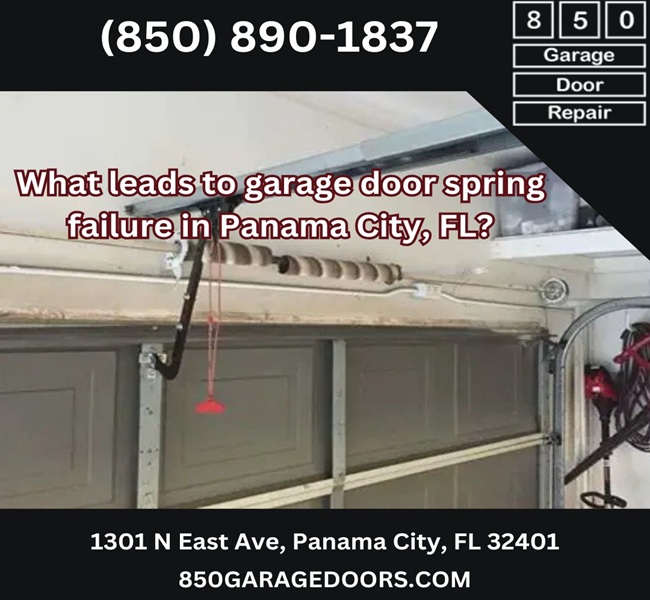
Panama City's Coastal Climate Is Hard on Garage Door Springs
Most garage door springs are made from high tension steel. Steel performs reliably under normal conditions, but the Florida Panhandle is far from a normal environment. The combination of coastal air, intense seasonal heat, and persistent moisture creates conditions that attack metal components in ways that are not immediately visible to the naked eye.
What makes this especially concerning is that the damage often develops quietly on the interior coils of the spring where it is not easy to spot during a casual inspection. By the time a homeowner notices something is wrong, the spring may already be close to its breaking point.
Salt Air From the Gulf Penetrates and Corrodes Spring Coils
Panama City sits along the Gulf of Mexico, which means salt particles travel through the air and settle on every exposed metal surface around your home, including your garage door springs. Over time, this salt deposits into the coiled structure of the spring and begins breaking down the metal at a molecular level.
Think of it this way: the same process that causes boat hardware and outdoor railings to corrode along the coast is working on the steel coils inside your garage. The difference is that those springs are under thousands of pounds of tension at all times. Corrosion weakens the tensile strength of the metal, and a corroded spring under full tension does not gradually fail. It snaps suddenly and without warning.
Heat Cycling Between Summer Highs and Cooler Months Weakens Metal
Panama City summers push temperatures well into the upper 90s, and garage interiors can climb even higher when there is limited airflow. When fall and winter arrive, temperatures drop significantly. This back and forth temperature swing is called heat cycling, and it causes metal to expand and contract repeatedly over time.
Every expansion and contraction cycle creates microscopic stress within the steel. Over months and years, this stress accumulates at specific points along the spring coil. Those stress points become weak zones where a break is most likely to originate. Springs in coastal Florida communities experience this thermal stress more aggressively than springs in temperate climates, which shortens their effective service life.
High Humidity Accelerates Rust Where Protective Coatings Break Down
Florida's humidity levels are among the highest in the country. When the protective oil coating or galvanized finish on a garage door spring begins to wear away, bare metal is exposed directly to moist air. Rust forms quickly in this environment, and it does not just sit on the surface. It spreads inward, pitting the metal and reducing the cross section of the coil wire.
A rusted spring cannot safely handle the same load it was designed to carry. Even if the spring appears intact from the outside, internal rust can reduce its effective strength by a significant margin before any visible fracture appears. When that threshold is crossed, Broken Garage Door Spring Repair becomes the only safe path forward.
Mechanical Factors That Compound the Problem
Climate is a major driver of spring failure in Panama City, but it is not the only one. There are also purely mechanical reasons a spring fails, and when those factors combine with coastal wear, the timeline to failure shortens considerably.
Every Spring Has a Finite Cycle Count and Most Homeowners Do Not Know Theirs
A standard residential garage door spring is rated for a specific number of open and close cycles, typically somewhere between 10,000 and 20,000 depending on the grade of spring installed. Each time you open or close your garage door, one cycle is used.
A household that opens and closes the garage four times per day will reach 10,000 cycles in roughly seven years. A busier household may get there in five. Most homeowners have no idea how many cycles their springs have accumulated or what the rated lifespan of their current springs actually is. This lack of visibility means the spring is often approaching the end of its service life with no maintenance or inspection ever having been performed.
Improper Spring Sizing Creates Uneven Tension from Day One
Garage door springs must be precisely matched to the weight of the door they support. A door that is too heavy for its springs places those springs under chronic overload. A door that is lighter than what the springs are calibrated for creates a different problem: excess tension that forces the spring to work at the outer edge of its design tolerance on every single cycle.
Both scenarios accelerate wear significantly. Improper sizing is not always the result of negligence. Doors get replaced or modified over time, and springs are not always updated to match. Insulation panels get added. Wood overlays increase weight. These changes can shift the load enough to create a mismatch that was never there originally.
How an Undersized Spring Reaches Its Failure Point Years Early
When a spring is undersized for the door it supports, the wire inside the coil is stretched closer to its tensile limit every time the door operates. This constant near maximum stress does not allow the metal to recover between cycles the way a properly sized spring would. The result is accelerated metal fatigue at a cellular level, and the spring reaches its mechanical failure threshold years before it should under normal loading conditions.
Warning Signs a Spring Is Close to Failing
Garage door springs rarely give extensive warning before they break, but there are observable signs that something is wrong. Catching these early gives you the opportunity to address the problem before it becomes an emergency.
| Warning Sign | What It May Indicate |
|---|---|
| Door feels unusually heavy when lifted manually | Spring tension is reduced, meaning the spring is no longer carrying its share of the door weight |
| Door opens unevenly or tilts to one side | One spring may be weaker or more worn than the other, creating an imbalanced load |
| Loud bang or pop from the garage area | A spring may have already snapped; this sound is often described as similar to a gunshot |
| Visible gaps or separation in the spring coil | The spring has already broken and must be replaced before the door is operated again |
| Door reverses immediately after beginning to close | Spring tension is uneven and the opener is sensing resistance it cannot overcome safely |
What Panama City Homeowners Often Mistake for an Opener Problem
One of the most common misdiagnoses homeowners make is assuming their Garage Door Openers have failed when the actual problem is the spring. When a spring loses tension or breaks, the opener motor may struggle, stop, reverse, or simply refuse to move the door. The opener is responding correctly to an overloaded condition, but the root cause is the spring, not the motor. Replacing an opener in this situation does nothing to address the underlying failure.
What Happens When a Spring Snaps Completely
A fully broken garage door spring does not just leave you with a door that will not open. It creates a situation where the door becomes genuinely dangerous to interact with. Garage doors typically weigh between 150 and 400 pounds depending on the material and construction. The springs are what counterbalance that weight so the opener and cables can move the door with minimal force.
Why a Broken Spring Makes the Door Unsafe to Operate
When a spring snaps, the full weight of the door transfers to the cables, the opener, and in some cases to anyone attempting to lift the door manually. Cables can fray and snap under this sudden overload. An opener that is forced to carry full door weight can burn out its motor or strip its drive mechanism, which is why some homeowners find themselves facing unexpected Garage Door Opener Replacement costs after a spring failure. A person attempting to manually lift a door without functioning springs also risks losing control of hundreds of pounds of moving material.
The safest course of action when a spring breaks is to stop using the door entirely and contact a qualified garage door technician. This is not a repair that should be attempted without professional training and proper tools.
Spring Repair vs Full Spring Replacement in Panama City
Once a spring has failed, the question becomes whether to repair the immediate problem or take a more comprehensive approach. In most standard situations, a broken spring is replaced with a new one of the correct size and rating for the door. The old spring is removed, the new spring is wound to the proper tension, and the system is tested and adjusted before the job is complete.
When Coastal Wear Means Replacing Both Springs at Once
Many residential garage doors use two springs working in tandem. When one spring breaks, the other spring has been operating in the same coastal environment for the same amount of time and has accumulated the same number of cycles. If one has reached its failure point, the second is typically close behind.
For Panama City homeowners, replacing both springs at the same time is often the more practical decision. It avoids a second service call in the near future, ensures both springs are calibrated to work together properly, and resets the cycle count on both components simultaneously. The cost of a second trip and a second installation generally exceeds the cost of replacing the paired spring during the initial visit.
Conclusion
Garage door spring failure in Panama City, FL comes down to a combination of forces working against the same component at the same time. Gulf Coast salt air corrodes coil metal from the inside out. Seasonal heat cycling creates stress fractures over time. High humidity feeds rust wherever coatings thin out or chip away. On top of those environmental factors, natural cycle fatigue and improper spring sizing push the timeline forward even further.
Recognizing the warning signs early, understanding what is actually failing inside your door system, and choosing to have both springs evaluated rather than just the one that broke are all decisions that protect your home and your family.
If your garage door is showing any of the signs described in this post, or if you simply want a professional inspection before a problem develops, 850 Garage Doors is ready to help. The team serves Panama City and the surrounding Florida Panhandle with the hands on experience coastal homeowners need, offering everything from spring repair to New Garage Door Installations. Visit 850garagedoors.com to learn more or to schedule service today.