

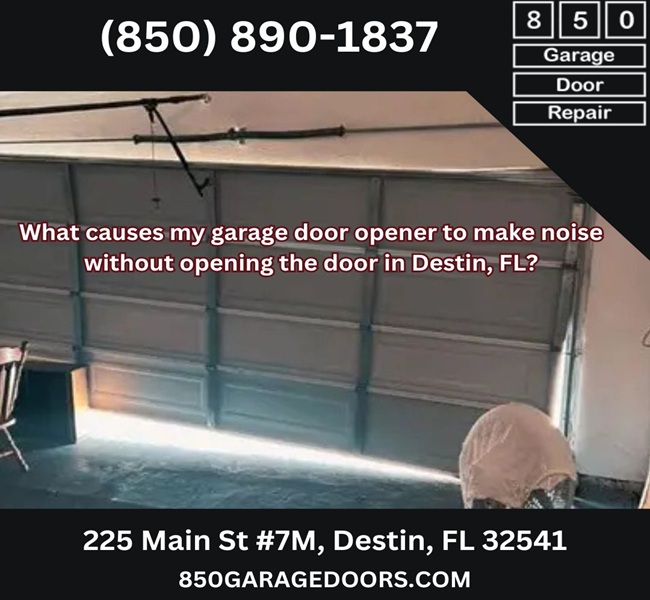
Why Your Garage Door Opener Runs But the Door Stays Shut
A garage door opener is only one part of a two part system. The opener itself is the motorized unit mounted to your ceiling. The door is a separate mechanical assembly that relies on springs, cables, rollers, and tracks to move. When the opener activates and the motor hums, clicks, or grinds without any movement from the door, the problem almost always lives in the mechanical system rather than the opener itself. The motor is doing its job. Something else has failed and is blocking the process.
Here are the three most frequent causes behind this symptom in Destin homes.
Broken Torsion or Extension Springs
Garage door springs carry the full weight of the door. A standard two car garage door in Florida can weigh between 150 and 200 pounds, and torsion springs do the heavy lifting so your opener motor does not have to. When a spring breaks, the opener tries to pull a load it was never designed to handle alone. The motor strains, you hear the mechanism running, and the door barely moves or stays completely still.
Torsion springs are rated for a certain number of cycles, typically around 10,000 openings and closings. In coastal Florida, humidity, salt air, and heat cycling push springs past their design limits faster than in drier inland climates. A spring that might last seven to ten years in Atlanta may show signs of fatigue in four to six years on the Emerald Coast.
If you hear a loud bang from the garage before noticing the problem, a spring likely snapped. You may also notice the door feels extremely heavy when lifted manually, or one side appears to hang lower than the other. In those situations, prompt Broken Garage Door Spring Repair from a licensed technician is the safest next step.
Stripped Drive Gear or Sprocket Inside the Opener Unit
Inside your opener unit sits a set of plastic or nylon gears that transfer the motor's power to the drive mechanism. These gears are intentionally made from softer material so they fail before the motor does, acting as a sacrificial component to protect the more expensive parts.
When a gear strips, the motor spins freely without engaging the drive. You hear the motor running, often with a distinctive whirring or grinding sound, but no movement happens at all. This is common in openers that are more than eight years old or in systems where a broken spring forced the opener to overwork for an extended period before the owner noticed.
A stripped gear is a repair that requires disassembling the opener head, sourcing the correct replacement gear kit for your specific brand and model, and reassembling the unit with proper alignment. It is not a roadside fix, but it is a straightforward repair for a technician experienced in Garage Door Openers and their internal drive components.
A Damaged or Disconnected Trolley Carriage
The trolley carriage is the component that rides along the opener rail and physically pushes and pulls the door arm to move the door. Every opener also has a red emergency release cord hanging from the trolley. When pulled, it disconnects the door from the drive so you can open the door manually during a power outage.
If that disconnect was triggered accidentally, by a child pulling the cord or by someone unfamiliar with how it works, the motor will run through its full cycle with zero connection to the door. The result is exactly the symptom you are experiencing: sound with no movement.
Beyond accidental disconnection, trolley carriages can crack, wear down, or break under repeated stress, particularly in openers that have been running against a binding door or a failing spring for an extended period. A visual inspection of the rail and trolley while the opener cycles can often reveal this issue immediately.
What the Noise Is Telling You
Not every opener noise sounds the same, and the specific sound you hear is a useful diagnostic clue. Below is a reference guide to the most common sounds associated with this problem and what each one typically indicates.
| Noise Type | Likely Cause |
|---|---|
| Loud snap or bang followed by motor running | Broken torsion or extension spring |
| Continuous whirring with no door movement | Stripped drive gear or sprocket inside the opener |
| Motor runs through full cycle, door does not budge | Trolley carriage disconnected from the drive rail |
| Grinding or clicking sound during operation | Worn sprocket, broken cable, or obstruction in the track |
| Humming with slight door movement then reversal | Limit switch malfunction or partially broken spring |
Use this table as a starting point for your conversation with a technician, not as a self repair guide. Identifying the noise gets you closer to the answer, but proper diagnosis still requires a hands on inspection of the full system.
How Destin's Coastal Climate Accelerates These Failures
Homeowners who relocate to the Florida Panhandle from other states are often surprised by how quickly garage door hardware deteriorates. What might be a gradual ten year wear curve in the Midwest can become a five year problem on the Emerald Coast. The reasons come down to two powerful environmental forces working on your hardware every single day.
Salt Air Corrosion on Springs and Metal Hardware
Living within a few miles of the Gulf of Mexico means your garage door springs, cables, hinges, and tracks are constantly exposed to airborne salt particles. Salt accelerates oxidation, which weakens metal at a structural level. Torsion springs are especially vulnerable because they are under constant tension and any surface corrosion becomes a stress point that can lead to an early break. Rollers are equally at risk, making timely Garage Door Rollers Repair an important part of maintaining a coastal home.
Standard springs that come stock on most doors are not treated for coastal conditions. Upgrading to galvanized or powder coated springs at installation is a worthwhile investment for Destin homeowners, and scheduling annual lubrication with a lithium based or silicone spray helps slow the corrosion process between service visits.
Heat and Humidity Cycling on Drive Components
Northwest Florida summers push heat indexes well above 100 degrees. The inside of an uninsulated or poorly ventilated garage can exceed that significantly. This heat causes metal components to expand and contract through daily cycles, gradually weakening joints, wearing down lubricants, and stressing plastic drive gears beyond their rated tolerances.
High humidity compounds the issue by trapping moisture inside the opener housing and along the rail, which accelerates rust on chain drives and promotes corrosion on circuit boards in the opener unit. A garage door system in Destin is quite literally working harder than the same system would anywhere in the country with a more temperate climate.
Why This Is Not a Safe DIY Repair in Destin, FL
It is natural to want to troubleshoot the problem yourself before calling a technician. For some home repairs, that is a reasonable approach. Garage door springs are a firm exception to that general rule.
Torsion springs are wound to an extreme level of tension. A single torsion spring on a standard residential door can store enough energy to cause catastrophic injury if it releases unexpectedly during handling. Professional technicians use specialized winding bars, cones, and safety cables to manage that tension safely. Attempting to adjust, replace, or even inspect a loaded spring without that equipment and training puts you at serious risk of injury.
The same caution applies to cables, which are under significant load and can snap and whip without warning, and to opener gear replacements, which require proper alignment to avoid burning out the motor after reassembly and creating the need for a full Garage Door Opener Replacement.
Beyond personal safety, an improperly repaired garage door is a liability risk for your home. A door that appears functional but has been incorrectly serviced can fail again quickly, sometimes in ways that cause property damage or injure a vehicle or family member. The repair cost of having a professional do the job right the first time is always lower than the cost of fixing a DIY attempt that went wrong.
Get a Same Day Diagnosis From a Local Destin Garage Door Expert
If your garage door opener is running but the door refuses to open, do not keep cycling the motor hoping the problem resolves. Repeated activation against a broken spring or stripped gear puts additional strain on components that are already failing and can turn a straightforward repair into a more involved one.
The right move is to stop using the door, avoid manual operation until the system has been evaluated, and contact a qualified garage door technician who understands the specific demands of coastal Florida hardware.
850 Garage Doors serves homeowners throughout Destin and the surrounding Florida Panhandle with hands on diagnostics and repair services for exactly this type of problem. Whether the issue is a broken spring, a stripped gear, a disconnected trolley, or a combination of several worn components working together, the team at 850 Garage Doors can identify the root cause and restore your door to safe operation.
Conclusion
A garage door opener that runs without moving the door is almost always a sign of a mechanical failure somewhere in the system, most often a broken torsion spring, a stripped drive gear, or a disconnected trolley carriage. In Destin, these failures tend to come sooner than homeowners expect because salt air corrosion and the relentless Gulf Coast heat push hardware past its limits faster than in less demanding environments.
The noise your opener makes is a useful diagnostic clue, but the repair itself is not something to approach without professional training and equipment. Garage door springs operate under extreme tension, and the risk of serious injury during an amateur repair attempt is not worth taking.
If you are hearing your opener run without results, the team at 850 Garage Doors is ready to help. Reach out today or visit 850garagedoors.com to schedule a same day service call and get your garage door working safely again.