

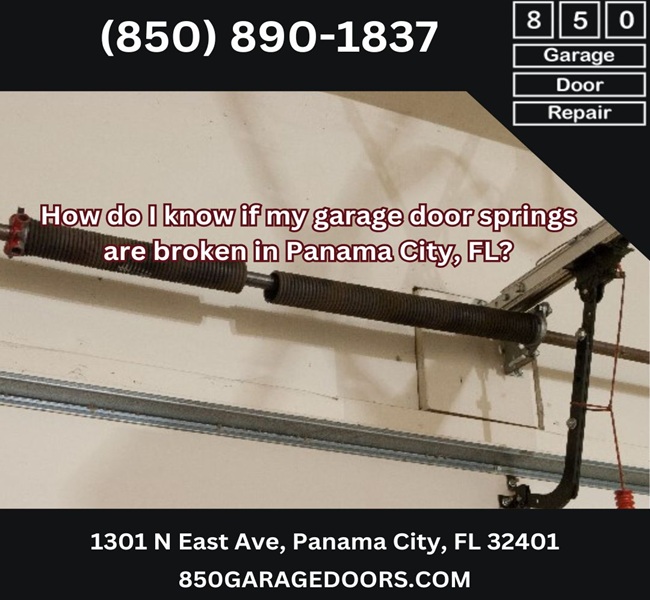
Broken garage door springs are one of the most common garage door repair issues homeowners face, and detecting them early can save you from a complete system breakdown. If your garage door is moving slowly, making loud noises, or won't open all the way, a broken spring is often the culprit. In Panama City, where coastal humidity and salt air accelerate metal degradation, spring failures happen faster than in other regions. The good news is that understanding the warning signs can help you identify the problem early and know when it’s time to call for professional garage door repair before your door becomes completely unusable, potentially trapping your vehicle inside or creating a safety hazard for your family.
5 Signs Your Garage Door Springs Are Broken (And Why You Need Help Fast)
Garage door springs are engineered to handle thousands of open and close cycles over their lifetime. However, they don't last forever, and when they fail, your entire door system becomes compromised. Recognizing these five key indicators will help you know exactly what's happening and when to call a professional.
What Broken Garage Door Springs Look Like (The Diagnostic Quick-Check)
Spring failure rarely happens without warning signs. The key is knowing what to look for and where to look. Most homeowners can identify a broken spring by observing their door from outside the garage, but you need to know what you're looking at.
Visual signs you can spot from your driveway
Walk out to your garage and look at the springs mounted above your door opening. Torsion springs (the most common type) sit horizontally across the top of the door frame. If the spring is broken, you may see a visible gap where the spring has split, often near one of the end plates. The spring might look noticeably stretched or compressed compared to what you remember. In some cases, you'll see one coil separated from the rest of the spring assembly. Another telling sign is if one side of your door sits lower than the other when closed, which indicates uneven spring tension.
Sounds that indicate spring failure
A broken spring produces a distinctive sound that most homeowners describe as a loud "bang" or "crack" when it fails. If you heard a sudden loud noise when your garage door was in use, and the door stopped working immediately afterward, you likely experienced a spring break at that exact moment. Ongoing sounds after the failure include a creaking or groaning noise when the door tries to move, as the opener motor struggles to lift the door without proper spring support. Some customers report hearing a whistling sound near the spring assembly, which can indicate metal fatigue before a complete break occurs.
Performance changes that confirm the problem
The most obvious performance indicator is that your garage door won't open at all, or it opens only a few inches before stopping. Your door might open very slowly, moving at a fraction of its normal speed, as the garage door opener motor is forced to work much harder without spring assistance. You may notice the door is stuck in the halfway position and won't budge in either direction. Some doors will close partway and then stop, refusing to complete the cycle. Additionally, if you try to manually lift the door by hand (with the opener disconnected), a functioning spring should make the door feel relatively light. A broken spring makes the door feel extremely heavy and difficult to move, even for two people working together.
Why Panama City's Coastal Climate Accelerates Spring Failure
While garage door springs fail eventually everywhere in the country, homeowners in Panama City face a unique environmental challenge. The combination of salt air, high humidity, and temperature fluctuations creates accelerated metal degradation that is significantly faster than inland areas.
Salt air corrosion on metal springs
Panama City's proximity to the Gulf of Mexico means your garage is exposed to salt-laden air on a regular basis. Salt is highly corrosive to metal, and your garage door springs bear the brunt of this exposure. The salt particles settle on the spring's surface and begin eating away at the protective coating. Over time, this creates tiny pits and weaknesses in the metal. Unlike uniform wear, corrosion creates stress points where the metal is already compromised before normal stress loads are applied. Springs that might last 10 to 12 years in a drier climate often fail at the 6 to 8 year mark in Panama City simply due to salt corrosion.
Humidity cycles and metal fatigue
Panama City's humidity levels fluctuate dramatically between seasons and even within single days. This constant expansion and contraction of metal creates micro fractures that accumulate over time. Steel springs experience what engineers call "fatigue cycling," where repeated stress cycles (in this case, from humidity and temperature changes) reduce the material's ability to withstand normal operating loads. The springs weaken gradually, and homeowners often don't notice until the spring finally gives way under normal use.
How seasonal humidity spikes affect torsion springs
During Panama City's humid summer months, moisture penetrates the garage environment and can even make its way into the spring assembly. Rust formation begins in microscopic areas first, and by the time rust becomes visible on the spring surface, internal corrosion may already be well underway. Torsion springs are under extreme tension, typically holding between 100 and 250 pounds of force depending on door size and weight. When rust weakens even a small section of the spring, that section cannot distribute the load properly, causing all the stress to concentrate on nearby areas. This concentration of stress leads to rapid failure.
The Hidden Cost of a Broken Spring You Might Miss
Many homeowners think a broken spring is just one problem that needs fixing. The reality is more complex. A broken spring creates a cascade of additional issues throughout your entire garage door system.
Increased strain on your garage door opener
Your garage door opener is designed to work in partnership with your springs. The springs support 90 percent of the door's weight, and the opener handles the remaining 10 percent plus the motion control. When a spring breaks, the opener suddenly has to support the full weight of the door, plus try to create the motion the homeowner expects. This forces the motor to work far harder than it was engineered to handle. The result is premature failure of the opener motor, and you end up replacing both the spring AND the opener instead of just the spring.
Safety risks to your vehicle and home
A door that won't open or is stuck in a partially open position creates obvious problems for your vehicle. But the safety risk goes deeper. A broken spring means there is no counterbalance holding the door in place. If the opener fails or the door is nudged by wind, the full weight of the door can come crashing down. A standard two-car garage door weighs between 300 and 400 pounds. This weight falling unexpectedly can cause serious injury to anyone beneath it and will cause severe damage to any vehicle positioned underneath.
Why a stuck door can trap a car (emergency scenario)
Imagine needing to leave your house quickly due to an emergency, only to find your garage door won't open because of a broken spring. Your car is trapped inside. Alternatively, your door closes while you're underneath it, or you're walking past it when it suddenly drops. In Panama City, where hurricane season brings high winds, a door with a broken spring is particularly vulnerable to wind-induced failures. A door that should stay in place can suddenly fall due to inadequate spring tension combined with wind pressure.
| Spring Failure Indicator | What This Means |
|---|---|
| Visible gap or separation in spring coils | Spring has fractured and cannot support door weight safely |
| Loud bang or crack sound followed by door stopping | Spring failure occurred at that exact moment; opener cannot lift door alone |
| Door opens only a few inches or not at all | Opener motor is overwhelmed without spring support and cannot complete cycle |
| Door feels extremely heavy when manually lifted | Springs are not providing lift assistance; full weight is on your hands |
| One side of door sits lower than the other when closed | Uneven spring tension or spring failure on one side of assembly |
Why DIY Spring Replacement Is More Dangerous Than You Think
After discovering their spring is broken, many homeowners look online for DIY repair instructions. This is understandable, but it's also where genuine safety hazards enter the picture. Garage door springs are not like other home repairs.
Spring tension can cause serious injury
A torsion spring under tension holds approximately 200 to 250 pounds of force (some high-lift doors hold even more). If you're working on a spring and it suddenly releases or slips, that energy will be transferred to your body. The injuries resulting from spring failure during DIY attempts include crushed fingers, broken hands, facial lacerations, and in severe cases, puncture wounds to the chest or abdomen. Emergency rooms across the country see these injuries regularly, and most occur during DIY spring replacement attempts. Professional technicians use specialized equipment and techniques specifically designed to control this tension safely.
Improper installation voids warranties
If you install a new spring yourself and something goes wrong later, you have no warranty protection. Manufacturer warranties require professional installation by a certified technician. If your door malfunctions weeks after a DIY spring installation and you need a new opener due to damage, you're paying out of pocket. Additionally, if someone is injured by a door system you installed yourself, liability issues emerge that your homeowner's insurance may not cover.
Misalignment creates additional repair costs
Springs must be installed with precision. The tension needs to be perfectly balanced on both sides of the door to ensure the door opens and closes evenly. If one spring is too tight and the other too loose, the door will roll sideways as it moves, eventually damaging the tracks, rollers, and hinges. What started as a single broken spring repair becomes a complete system rebuild. Professional technicians have tools to measure and adjust spring tension to exact specifications, ensuring your entire system works in harmony.
How Professional Spring Replacement Solves This (And Costs Less Than You'd Expect)
Professional spring replacement is the safe, practical solution that most homeowners should choose. The process is straightforward, the results are reliable, and the peace of mind is invaluable.
Same-day service availability in Panama City
When you contact a professional garage door service, your door can usually be repaired the same day you call. Technicians arrive with the correct spring for your specific door model and size, the specialized tools needed to safely replace it, and the expertise to complete the job quickly. Most spring replacements take between one and two hours. You're not left waiting days for repairs or dealing with a non-functional garage door during that waiting period.
Warranty protection on parts and labor
Professional spring replacement comes with a warranty covering both the new spring itself and the labor performed. This warranty typically extends one to three years, depending on the service provider. If the spring fails prematurely, or if something goes wrong with the installation, the warranty covers the fix. This protection gives you confidence that your investment is secure.
Preventing secondary damage to your system
A professional technician inspects the entire garage door system while they're there. They check the condition of your opener, examine the tracks and rollers, and make sure everything is balanced correctly. They can identify other potential problems before they become failures. This preventive approach saves you money in the long run by catching issues early and ensuring your entire system operates efficiently.
Ready to Get Your Garage Door Working Again?
A broken garage door spring is not something to ignore or tackle yourself. The safety risks are real, the financial costs of additional damage are significant, and the inconvenience of a non-functional door affects your daily life. Panama City homeowners understand that the coastal environment works against metal components, and springs are particularly vulnerable. Professional spring replacement is fast, safe, and affordable.
If you're experiencing any of the signs discussed in this post, or if you suspect your garage door spring may be failing, reach out to 850 Garage Doors today. Our experienced technicians are ready to diagnose your door, provide a solution, and get your garage door working safely again. Visit us at 850garagedoors.com to learn more or schedule your service.
Conclusion
Knowing how to identify a broken garage door spring puts you in control of the situation. The five signs covered in this post are visual indicators, sounds, and performance changes that clearly signal spring failure. Panama City's unique coastal environment accelerates spring degradation through salt corrosion and humidity cycling, meaning springs may fail earlier than they would in other regions. While a broken spring creates cascading problems throughout your door system, the solution is straightforward: professional spring replacement.
DIY attempts are dangerous and costly, but professional service is safe, reliable, and comes with warranty protection. If you're dealing with a stuck garage door or suspect a broken spring, the answer to "How do I know if my garage door springs are broken in Panama City, FL?" becomes clear once you recognize these warning signs. Don't let a broken spring turn into a bigger problem. Reach out to 850 Garage Doors and let our team handle it the right way. Your safety and peace of mind are worth it.