

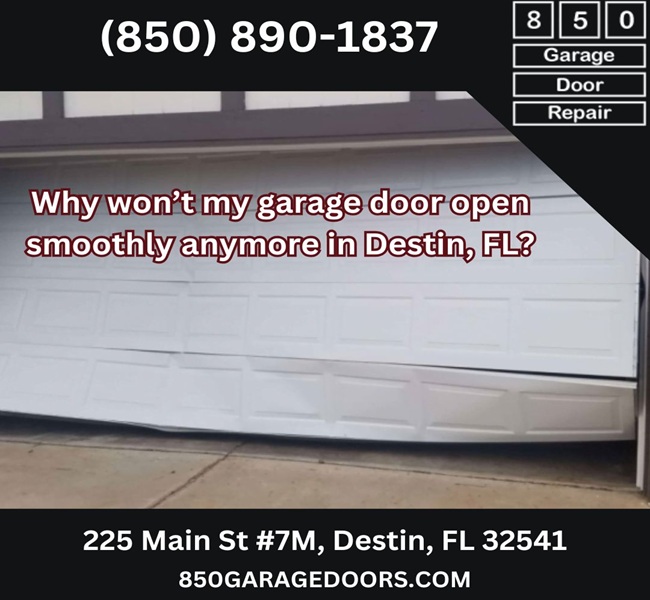
If your garage door has started moving in a jerky, grinding, or sluggish way, the most likely cause is worn hardware combined with the accelerated corrosion that Destin's coastal environment puts on every metal component in your system. Salt air, high humidity, and intense heat cycles work against your garage door year-round in ways that homeowners in inland markets simply never experience. What starts as minor resistance or an unfamiliar sound can quickly develop into a safety concern or a full component failure. Understanding what is actually happening inside your system is the first step toward getting it working properly and protecting your investment long term. If you are already dealing with noticeable problems, professional garage door repair is the most reliable path to restoring safe, smooth operation.

The Real Reason Garage Doors Stop Moving Smoothly in Destin
Most homeowners assume a rough-running garage door is just a sign of age. In Destin, that assumption often leads to delayed repairs that turn manageable problems into expensive ones. The environment here plays a direct and ongoing role in how quickly garage door components wear down, and recognizing that connection makes it much easier to understand what your door is trying to tell you.
How Destin's Coastal Climate Quietly Destroys Garage Door Components
Destin sits along the Gulf of Mexico, which means the air that moves through your garage every time that door opens carries microscopic salt particles. Those particles settle on springs, rollers, hinges, and tracks and begin breaking down protective coatings and bare metal surfaces over time. Add in relative humidity levels that regularly exceed 80 percent during summer months, and you have conditions that accelerate corrosion at a rate two to three times faster than what the same components would experience in a dry, inland climate.
The result is that components rated for a certain lifespan by their manufacturers often reach the end of their useful life well ahead of schedule in coastal Florida. A roller that might last eight to ten years in Tennessee may need attention in four to five years in Destin. That is not a defect. That is the reality of operating mechanical equipment in a salt air environment without a maintenance plan built around local conditions.
The Difference Between a Door That Sticks and a Door That's Failing
A door that occasionally hesitates on a particularly humid morning is behaving differently from a door that resists movement every single cycle. Sticking is often a lubrication or minor debris issue. Failing is when underlying components are worn, corroded, or misaligned to the point where the door cannot move as designed. The distinction matters because a failing door does not improve on its own. It degrades further with each operation, and the forces involved in a garage door system are significant enough that a component failure mid-cycle can cause serious damage or injury.
Most Common Causes of a Jerky or Resistant Garage Door
Several individual components can cause a door to lose its smooth operation. Often, more than one is contributing at the same time. Here is a breakdown of the most frequent culprits in Destin homes.
Worn or Corroded Rollers Creating Friction Along the Track
Rollers are the small wheels that guide your door along its vertical and horizontal tracks. Standard steel rollers are particularly vulnerable to salt air corrosion. As the bearing inside the roller degrades, the roller stops spinning freely and begins dragging instead. That dragging creates friction, which your opener motor has to overcome on every cycle. You may hear a scraping or grinding sound, and the door may visibly shudder as it moves. Nylon rollers with sealed bearings perform considerably better in coastal environments, but even those require periodic inspection.
When roller wear has progressed to the point where the door is no longer tracking cleanly, Garage Door Rollers Repair by a trained technician is the right next step rather than continuing to run the system and risk scoring the track surface.
Garage Door Spring Tension Imbalance
Your garage door relies on torsion or extension springs to counterbalance its weight. When springs are properly tensioned, the door feels nearly weightless and moves with minimal effort from the opener. When a spring loses tension due to fatigue or corrosion, the opener is forced to carry a disproportionate share of the door's weight. The door may move slowly, hesitate at certain points in its travel, or feel noticeably heavier when operated manually. Spring issues in Destin are common because the combination of salt air and moisture shortens spring lifespan considerably compared to manufacturer estimates.
A spring that has lost tension or broken entirely needs to be addressed before further damage occurs throughout the system. Broken Garage Door Spring Repair is not a repair homeowners should attempt on their own given the mechanical energy stored in a loaded spring.
Track Misalignment From Humidity Warping and Salt Air Exposure
Garage door tracks need to be plumb, level, and consistent in their spacing from the door panels. When tracks shift even slightly due to bracket corrosion, fastener loosening, or minor impacts, the door no longer travels in a clean path. Rollers bind against track edges, panels catch at transition points, and the opener strains to pull the door through a path it was not designed to navigate. In Destin's climate, track hardware is subject to the same accelerated corrosion as every other component, and annual inspection of track alignment is a meaningful preventive measure.
Opener Motor Struggling Against Mechanical Resistance
A garage door opener is designed to move a properly balanced, well-lubricated door. It is not designed to compensate for multiple failing mechanical components simultaneously. When rollers are dragging, springs are under-tensioned, and tracks are misaligned, the opener motor absorbs all of that resistance. Over time, this shortens the opener's lifespan and can trigger the automatic reversal feature, causing the door to stop partway through its travel. If your opener sounds labored or your door reverses without hitting an obstruction, mechanical resistance is a likely cause.
Understanding how Garage Door Openers interact with the mechanical components they drive is key to diagnosing why a system that worked fine for years has suddenly started struggling.
Lack of Lubrication Accelerated by Gulf Coast Heat and Humidity
Lubrication evaporates faster in high heat environments. Destin summers regularly push into the mid-90s with high humidity, which means lubricants applied to springs, hinges, and rollers can break down or thin out within a few months rather than lasting a full year. Dry metal components moving against each other generate friction, noise, and wear at a rate that properly lubricated components never experience. Using the right lubricant, applied to the right components, on a schedule that accounts for local climate conditions is a straightforward way to extend hardware life significantly.
How to Tell Which Component Is Actually Causing the Problem
One of the most practical things a homeowner can do is observe the door carefully during a few full cycles and take note of where in the travel the problem occurs, what sounds accompany it, and whether the issue is consistent or intermittent. The table below connects common symptoms to their most likely root causes.
| Symptom You Observe | Most Likely Cause |
|---|---|
| Door shudders or shakes while moving up or down | Worn or corroded rollers dragging along the track |
| Door moves slowly and opener sounds strained | Spring tension loss causing excessive load on the motor |
| Door catches or binds at a specific point in travel | Track misalignment or a bent track section |
| Grinding or squealing noise throughout full cycle | Dry hinges, rollers, or springs lacking adequate lubrication |
| Door reverses before fully opening or closing | Opener sensing excess resistance from multiple worn components |
Warning Signs You Should Never Ignore
Not every symptom carries the same level of urgency, but some indicate conditions that put both your property and your safety at risk if left unaddressed.
Sounds That Signal Immediate Safety Risk
A loud bang coming from the garage, particularly when the door is in motion or when you activate the opener, often indicates a spring failure. Torsion springs store a significant amount of mechanical energy and when one breaks, the release is sudden and forceful. This is not a situation where continued operation is advisable. A popping or snapping sound from the cable area carries similar urgency. Both warrant an immediate service call rather than continued use of the door.
Visual Cues That Indicate Component Failure
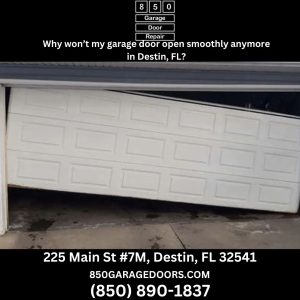
Visible gaps in a torsion spring coil, cable slack or fraying, rollers that have slipped out of the track, or panels that have shifted out of alignment are all signs that something has already failed rather than something that is wearing toward failure. If you can see daylight between panels that previously sat flush, or if the door hangs at an angle when stopped, do not attempt to operate the door until a qualified technician has assessed it.
Why Destin Homeowners Experience This Problem More Than Most
The mechanical components inside a garage door system were not all designed with the Gulf Coast in mind. Understanding the specific stressors that Destin's environment creates helps explain why this issue comes up so regularly among local homeowners.
Salt Air Corrosion Timelines vs. Inland Markets
The National Association of Corrosion Engineers has documented that metal corrosion rates near coastal environments can be significantly higher than in dry inland regions. For garage door hardware, this translates into practical terms: springs, hinges, roller bearings, and track hardware in Destin require inspection and maintenance on a shorter cycle than what standard manufacturer schedules recommend. Those schedules are typically written for average conditions, and Destin is not average. Homeowners who follow coastal-appropriate maintenance intervals consistently report fewer emergency repairs and longer overall system life than those who follow the generic guidance.
Seasonal Humidity Cycles and Their Impact on Door Hardware
Florida's wet season runs roughly from June through September, during which humidity and rainfall are significantly elevated. This period accelerates the moisture intrusion that drives corrosion on unprotected metal surfaces. The transition between wet and dry season also creates expansion and contraction cycles in metal hardware that gradually loosen fasteners and shift alignment over time. Homeowners who schedule a professional inspection at the end of each wet season are in a much better position to catch alignment and hardware issues before they compound into more serious problems.
What Happens If You Keep Operating a Door That Won't Move Smoothly
It is tempting to continue using a door that is functioning, even if it is functioning poorly. In the short term, it still opens and closes. In the longer term, operating a mechanically compromised door creates a predictable pattern of worsening damage.
Cascading Damage That Turns a Small Repair Into a Costly Replacement
When rollers drag instead of roll, they score the inside surface of the track over time. A scored track cannot be simply lubricated back into good condition; it typically requires replacement. When an opener motor runs against heavy mechanical resistance on every cycle, it wears through its drive components faster than it would under normal load. Springs that are operating under uneven tension fatigue more rapidly at stress points, increasing the likelihood of sudden failure. Each component that fails under abnormal load conditions places additional strain on everything connected to it. What begins as a roller replacement can become a roller, track, opener, and cable job if the initial problem is ignored long enough.
The Safety Risk of a Door Under Mechanical Stress
A standard two-car garage door weighs between 150 and 250 pounds. The springs, cables, and tracks in the system are what keep that weight moving in a controlled, predictable way. When those components are compromised, the door's movement becomes unpredictable. A cable that snaps under load, a spring that breaks mid-cycle, or a roller that jumps the track can cause the door to drop, shift laterally, or fail to stop when commanded. For households with children, pets, or vehicles regularly passing through the garage, the risk profile of a mechanically stressed door is not trivial.
What a Professional Inspection Covers That Homeowners Miss
There is a meaningful difference between what a homeowner can observe from ground level and what a trained technician identifies during a structured inspection of the full system.
Multi-Point Diagnostic Process for Smooth Operation Restoration
A thorough professional inspection evaluates spring tension and balance, roller condition and bearing integrity, track alignment and fastener tightness, cable condition and drum seating, opener force settings and travel limits, and weatherseal condition. Each of these points contributes to how the door moves as a system. Addressing one without assessing the others often results in a temporary improvement followed by a return of the original problem, because the underlying contributing factors were not identified. In Destin's environment, a complete picture of system health is particularly important because multiple components are typically affected simultaneously by the same corrosive conditions.
When Repair Is the Right Call vs. Full Component Replacement
Not every worn component requires immediate replacement. A technician can assess whether a spring still has serviceable life remaining, whether track damage is localized or systemic, and whether rollers can be serviced or need to be swapped out entirely. The goal of a professional inspection is to give the homeowner an accurate picture of the system's current condition and a clear recommendation for what needs attention now versus what can be monitored. That honest assessment is what separates a service provider that is focused on your door's long-term performance from one that is simply focused on selling parts.
Get Your Garage Door Moving Smoothly Again in Destin
A garage door that hesitates, shudders, or strains to move is telling you something important. In Destin's coastal environment, those signals move from minor to serious faster than most homeowners expect. The good news is that catching and correcting the underlying causes early almost always results in a simpler, more straightforward repair than waiting until a component fails completely.
850 Garage Doors serves Destin and the surrounding Florida Panhandle with experienced technicians who understand the specific demands that Gulf Coast conditions place on garage door systems. Whether you need a same-day diagnosis, a preventive maintenance visit, or an emergency repair, the team at 850 Garage Doors is ready to help.
Call us directly to schedule your service appointment, or visit 850garagedoors.com to submit a contact form and a technician will follow up with you promptly. Do not wait for a small problem to become a safety issue. Get your door inspected and operating the way it should.
Conclusion
A garage door that no longer opens smoothly is rarely a single-component problem in Destin. Salt air corrosion, humidity-driven wear, lubrication breakdown, and track stress tend to develop together, each making the others worse over time. The homeowners who fare best are the ones who take early symptoms seriously and bring in a qualified professional before the situation escalates.
If you have been wondering why your garage door is not moving the way it used to, the answer almost certainly lies in one or more of the mechanical causes covered in this post combined with the accelerated wear that Destin's coastal climate produces. 850 Garage Doors has the local experience and technical knowledge to diagnose the real issue, explain your options clearly, and restore your system to reliable operation. In cases where repair is no longer the practical path forward, New Garage Door Installations are available with options suited for coastal Florida's demanding environment. Reach out today at 850garagedoors.com and take the first step toward a door that works the way it should.