

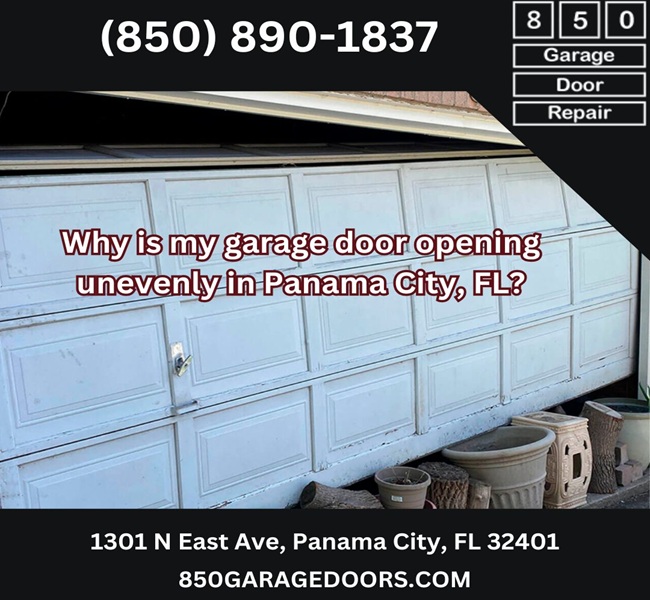
What Uneven Garage Door Movement Is Telling You
Most homeowners notice something is wrong before they can name it. The door sounds different. It moves slower on one side. It hesitates at a certain point in its travel. These are not random quirks. They are symptoms that point toward specific mechanical failures. Knowing how to read those symptoms helps you describe the problem accurately when you call a technician, and it helps you understand why the repair matters.
One Side Lags Behind the Other
When one side of the door rises faster than the other, the door is operating under uneven tension or uneven resistance. On a properly functioning door, both sides move at the same rate because the springs, cables, and rollers on each side are working in balance. The moment one component on either side degrades, the door tilts. You will see it in the gap at the bottom of the door as it lifts, one corner rising higher than the other. Over time, this tilting worsens, and the door can bind in the tracks entirely.
The Door Jerks, Shudders, or Stops Before Fully Opening
A door that jerks or shudders as it moves is dealing with a physical obstruction or a component that is no longer rolling smoothly through the track. Rollers that have cracked, flattened, or seized will cause the door to stutter. A bent section of track will cause it to jolt at the same point every time. A cable that has partially unraveled from its drum will cause sudden lurches. Each of these behaviors signals a different repair need, but all of them share a common thread: the system is no longer operating as a coordinated unit.
The Most Common Causes of an Uneven Garage Door
Several components work together every time your garage door opens and closes. When any one of them begins to fail, the door shows it immediately. Here are the components most often responsible for uneven movement.
Spring Imbalance or Failure
Springs do the majority of the heavy lifting on a garage door. They store tension when the door closes and release it when the door opens, effectively counterbalancing the weight of the door so the opener motor only needs to provide a small amount of force. When a spring loses tension, breaks, or wears unevenly on one side, that counterbalance disappears, and a Broken Garage Door Spring Repair becomes the necessary next step to restore safe and even door movement.
How One Broken Spring Pulls the Entire Door Off Balance
A garage door with a broken spring on one side will drop that corner significantly lower than the other. The opener will still attempt to lift the door, but it will be working against far more resistance than it was designed to handle. The result is a door that rises crookedly, strains the opener motor, and in many cases stops partway through its cycle because the opener's built in resistance sensor detects the overload and shuts the system down. This is a safety feature working as intended, but it also means your door will not function normally until the spring is replaced.
Worn or Damaged Rollers
Rollers are the small wheels that allow the door panels to travel up and down through the vertical and horizontal tracks. A standard residential door has between ten and twelve rollers, and each one takes a beating every time the door cycles. Over years of use, the nylon or steel wheels crack, flatten, or seize on their stems.
How a Failing Roller Changes the Door's Path Through the Track
When a roller fails, it no longer spins freely. Instead of rolling through the track, it drags. That dragging creates friction on one side that does not exist on the other, and the door responds by pulling toward the side with the bad roller. You will often hear a grinding or scraping sound alongside the uneven movement, and in some cases you will see visible scoring or wear marks on the inside of the track where the roller has been rubbing against the metal. A prompt Garage Door Rollers Repair prevents that friction from causing additional damage to the track over time.
Bent or Misaligned Tracks
The vertical and horizontal tracks on either side of the door must be perfectly parallel and properly spaced for the door to travel smoothly. Tracks can bend from an accidental vehicle impact, from years of vibration, or simply from the brackets loosening over time. Even a small bend or a gap where a section of track has shifted outward is enough to cause the door to bind, slow, or travel crookedly. A track that is even slightly out of alignment forces the rollers to fight their way through a path they were not designed to navigate.
Frayed or Slipped Lift Cables
Lift cables run along each side of the door, connecting the bottom corners to the spring drum above. They work in tandem with the springs to guide the door through its travel. A cable that has frayed, snapped, or slipped off its drum removes the mechanical support from that side of the door entirely. The result is immediate and dramatic: one side of the door will drop, the door will hang at an angle, and the opener will be unable to correct it. This is one of the more visually obvious failures because the cable itself is often visible along the side of the door frame.
| Component | How It Causes Uneven Movement |
|---|---|
| Torsion or Extension Spring | A broken or weakened spring removes the counterbalance on one side, causing that corner of the door to drop and rise more slowly than the other |
| Door Rollers | Worn or seized rollers create friction on one side of the track, causing the door to drag, stutter, or pull unevenly through its travel path |
| Vertical and Horizontal Tracks | A bent or misaligned track forces rollers out of their intended path, creating resistance that makes the door bind or move crookedly |
| Lift Cables | A frayed or slipped cable eliminates mechanical support on one side, causing that corner to drop and the door to hang at a visible angle |
| Opener Trolley or Drive | A failing trolley or worn drive chain can apply uneven pulling force to the door, producing jerking or inconsistent travel speed |
Why Panama City Homes See This Problem More Often
Garage doors in Panama City operate in one of the more demanding environments in the country. The combination of Gulf Coast humidity, salt air, and intense seasonal heat cycles accelerates the wear on every metal component in the door system. What might take eight to ten years to develop in a drier inland climate can surface in four to six years along the Florida Panhandle coastline.
Salt Air Corrosion on Springs, Cables, and Rollers
Salt particles carried in from the Gulf settle on every exterior surface, including the springs, cables, and roller stems on your garage door. Over time, that salt exposure promotes oxidation and surface corrosion on steel components. A corroded spring loses its tensile strength faster than a clean one. A corroded cable begins to fray at its outer strands before showing any obvious visible damage. Roller stems that have rusted inside their brackets create the kind of stiff, uneven resistance that throws off the door's balance. Panama City homeowners who are within a few miles of the water will almost always see accelerated component wear compared to homes farther inland.
Gulf Coast Heat Cycling and Humidity Effects on Metal Components
Florida's climate also subjects garage door hardware to significant thermal stress. Metal expands in heat and contracts when temperatures drop, and in a coastal Florida environment that cycle repeats hundreds of times per year. Springs that are already under tension experience additional stress with every temperature swing. Track brackets that expand and contract against their mounting points can loosen over time. Nylon rollers soften in extreme heat and can deform under the weight of the door, losing their round profile and developing flat spots that cause the stuttering and jerking movement homeowners often describe. Adding humidity into the equation means that any small scratch or wear point in a protective coating becomes an entry point for moisture and the corrosion it brings with it.
How to Tell Which Component Is Failing
Before calling a technician, there are a couple of safe observation steps you can take to gather information about the problem. These steps do not require you to touch any of the door hardware. They are purely visual checks that can help narrow down the cause.
The Manual Disconnect Test
Most Garage Door Openers have a red manual release cord that hangs from the trolley. Pulling this cord disconnects the door from the opener so it can be moved by hand. With the door disconnected and in the fully closed position, try lifting it slowly by hand from the center of the bottom panel. A properly balanced door should rise smoothly and stay in place when you stop at the midpoint, roughly three to four feet off the ground. If it immediately drops back down on one side, or if one side feels significantly heavier than the other, the spring system is almost certainly the issue. Do not attempt to force the door open if it feels extremely heavy or if you hear a snapping or grinding noise during this test.
What to Watch for on Each Side of the Door
Stand at the front of the garage and observe both sides of the door as it moves. Look at the cables running along each side: they should be taut and parallel to the door edge. A cable that is slack, looped, or visibly off its drum is a clear failure sign. Look at the rollers where they sit inside the track: they should be fully seated with no visible wobble. Look at the track itself for any kinks, gaps, or sections that appear to be pulling away from the wall. Any of these visual signs point directly to the component that needs attention.
Why Uneven Movement Should Not Be a DIY Fix
It is worth being direct about this: garage door spring and cable repairs are among the most physically dangerous home repair tasks a homeowner can attempt. This is not a matter of technical skill. It is a matter of the forces involved.
Spring Tension and Cable Danger Make This a Job for Trained Technicians Only
A residential torsion spring stores an enormous amount of mechanical energy when it is wound. A spring that releases that energy unexpectedly, whether during an attempted adjustment or simply because it has reached the end of its service life, does so with enough force to cause serious injury. The same is true of a cable under full load. Professional technicians use specific winding bars, cable drums, and safety protocols that are not part of a standard homeowner tool set. Beyond the physical danger, an improperly adjusted spring or cable can cause the door to fail in ways that damage the opener, the panels, or the track system, turning a single repair into a much larger and more costly one. The right call here is always to let a trained technician handle it.
What Professional Garage Door Service Covers in Panama City, FL
When a qualified technician arrives to assess an unevenly moving garage door, the inspection goes well beyond the single component that appears to be failing. A thorough service visit typically includes checking spring tension and condition on both sides, inspecting all rollers for wear or seizure, examining the track system for alignment and secure mounting, reviewing the cable condition and drum seating, and testing the opener's force settings to confirm it is not overcompensating for a mechanical problem elsewhere in the system.
In a coastal environment like Panama City, a good technician will also assess how salt exposure and humidity have affected the hardware overall, because fixing one corroded spring without addressing a corroded cable beside it simply means a second service call in the near future. In some situations, the technician may also advise on a Garage Door Opener Replacement if the unit has sustained wear from overworking against a mechanical fault over time. Comprehensive service accounts for the whole system, not just the part that failed today.
Closing Thoughts for Panama City Homeowners
An unevenly opening garage door is a signal that one or more of its structural components has reached or passed the point of safe operation. Whether the cause is a spring that has lost its tension, a roller that has seized in the track, a cable that has slipped off its drum, or a set of tracks that the Gulf Coast climate has slowly worked loose, the underlying message is the same: the system needs professional attention before the problem progresses.
Panama City homeowners deal with a coastal environment that is harder on garage door hardware than most parts of the country, and that makes routine attention to door performance more important, not less. If your door is showing any of the symptoms described in this post, the team at 850 Garage Doors is ready to help. Serving the Panama City area with experienced, honest garage door service, 850 Garage Doors brings the diagnostic expertise and local knowledge to get your door moving safely and evenly again. Reach out today or visit 850garagedoors.com to learn more about what we can do for your home.