

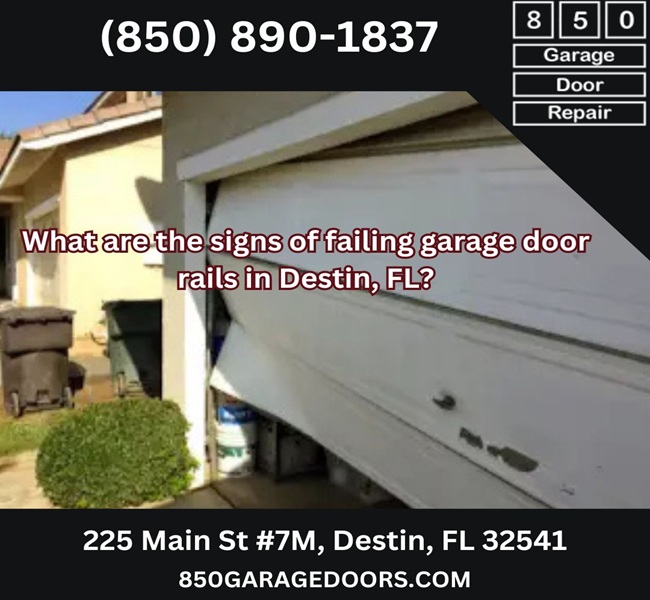
Why Garage Door Rails Are Under Extra Stress in Destin
Garage door rails, also called tracks, are the metal channels mounted to the wall and ceiling of your garage that guide the door panels up and overhead as the door opens. In most residential settings, these tracks are made from galvanized or coated steel, and they are engineered to last for many years under normal conditions. Destin is not a normal condition. The Florida Panhandle sits directly on the Gulf of Mexico, and the coastal environment here is genuinely harsh on metal components. The combination of salty ocean air, year round humidity, and the seasonal intensity of Gulf weather creates conditions that accelerate corrosion, loosen fasteners, and warp metal faster than most homeowners expect.
How Salt Air and Coastal Humidity Attack Metal Tracks Over Time
Salt air does not corrode metal overnight, but the process is relentless and cumulative. When microscopic salt particles settle on the surface of your garage door tracks, they begin drawing moisture out of the surrounding air and holding it against the metal. Over weeks and months, this creates a corrosive cycle that works beneath the surface coating before visible rust ever appears. By the time you can see the damage with your eyes, the structural integrity of the rail may already be compromised. High humidity compounds the problem significantly. Destin regularly sees humidity levels above 80 percent for extended stretches of the year. That sustained moisture exposure causes steel tracks to expand slightly, which loosens mounting hardware and shifts alignment over time. It also accelerates the breakdown of any protective coatings the manufacturer applied. What might take a decade to develop in a dry climate can show up in Destin within three to five years if the tracks are not maintained. Hurricane season adds a third layer of stress. High winds, wind driven rain, and debris impacts during storm events can bend or dent sections of track that would otherwise hold up for years longer. A track that looks intact after a storm may have a subtle deformation that quietly worsens with every door cycle.
Warning Signs Your Garage Door Rails Are Starting to Fail
Most failing rail systems give homeowners clear signals before they reach the point of complete failure. The challenge is knowing what those signals look like and understanding why they should not be ignored. The following warning signs are the ones that most consistently indicate a track system that needs professional attention.
Visible Bending, Gaps, or Rust Along the Track
Stand inside your garage and look directly at both vertical tracks, then follow the horizontal tracks overhead. A healthy rail system runs in a smooth, consistent line with no curves, kinks, or gaps between sections. If you notice any section that appears bent inward or outward, any point where the track has separated slightly from the wall mounting, or any surface rust that has progressed beyond a light surface discoloration, those are indicators that the rail has been structurally compromised. Even a small bend in the track creates a pinch point where the rollers must force their way through on every cycle. That repeated forcing accelerates wear on both the rollers and the track and often causes the kind of noise and movement irregularities described in the sections below.
Grinding, Scraping, or Popping Sounds During Operation
A properly functioning garage door system moves with minimal noise. You will hear the motor, and you may hear a gentle mechanical rhythm, but the door itself should travel relatively quietly. When the rails are failing, that changes. Grinding sounds typically indicate that the rollers are being forced against a track surface that is no longer smooth, either because of rust pitting, debris buildup, or a deformation in the rail. Scraping sounds often mean the roller has partially separated from the track and is dragging against the edge rather than riding cleanly inside the channel. Popping sounds tend to occur when a bent section of track snaps slightly under the pressure of the door passing through it. Any of these sounds warrant an inspection. They do not resolve on their own, and they consistently worsen with continued use.
The Door Shakes, Stutters, or Travels Unevenly
Watch your door through a complete open and close cycle. It should move in a single smooth motion with no visible wobbling, hesitation, or side to side movement. When the tracks are failing, the door often develops a characteristic shudder as it passes through damaged or misaligned sections. Uneven travel is particularly telling. If one side of the door appears to be moving faster than the other, or if the bottom of the door appears to tilt slightly to one side during operation, the rails on one side are likely out of alignment. This puts lateral stress on the door panels themselves and on the spring and cable system that balances the door, turning what started as a track problem into a much wider system issue that may eventually require Broken Garage Door Spring Repair if the added stress reaches the spring assembly.
The Door Reverses Before Closing or Stops Mid Cycle
Modern Garage Door Openers include auto reverse safety sensors, and those sensors are designed to stop the door when they detect resistance. When your door reverses before it reaches the floor, or stops partway through a cycle without any visible obstruction, the opener may be detecting the increased mechanical resistance created by a compromised track. This is one of the most commonly misdiagnosed garage door problems. Homeowners frequently assume the sensors need adjustment or the opener needs replacement, when the underlying cause is actually a rail that has bent, shifted, or corroded to the point where it is creating enough friction to trigger the safety system. Addressing the track resolves the behavior; addressing only the opener leaves the root cause in place.
Daylight or Gaps Visible Between the Roller and Rail
The rollers on your garage door are designed to sit fully inside the track channel with minimal space between the roller and the rail wall. If you look at the track while the door is in the closed position and notice that any roller is sitting at an angle, appears to be partially outside the channel, or has a visible gap on one side, the track geometry has changed. This condition is particularly dangerous. A roller that is partially outside the track is a roller that can fully exit the track under load, and a door that comes off its rails is a significant safety hazard. If you observe this in your system, the door should not be operated until the track has been professionally assessed.
Diagnostic Overview: Rail Warning Signs and What They Indicate
| Warning Sign | What It Indicates |
|---|---|
| Visible rust, bending, or gaps in the track | Structural degradation from corrosion or physical impact; track may be compromised beyond surface level |
| Grinding or scraping during operation | Rollers are forcing through a damaged or obstructed channel; further wear is occurring on every cycle |
| Door shaking or stuttering during travel | Track misalignment or deformation causing uneven roller travel; increasing stress on springs and cables |
| Door reverses or stops mid cycle unexpectedly | Opener safety system detecting friction caused by a compromised track rather than a sensor or motor issue |
| Gaps visible between roller and rail channel | Track geometry has shifted; roller is at risk of fully exiting the track, creating an immediate safety hazard |
What Is Causing Your Garage Door Rails to Deteriorate?
Understanding what is behind rail failure helps homeowners make more informed decisions about repair options and helps prevent recurrence after a repair is completed. In Destin, the causes tend to fall into three primary categories, and they frequently overlap.
Physical Impact or Accidental Vehicle Damage
The vertical sections of garage door track run along the side walls of your garage at roughly car door height. In a two car garage, that puts the track in a position where it can be struck by a vehicle door, a bicycle handlebar, a lawn mower, or any number of objects that get moved in and out of the garage on a regular basis. Even a moderate impact can create a dent or bend that is enough to alter the roller path. Impact damage is particularly common in households where the garage doubles as a storage area or workshop. The track sections near the floor are especially vulnerable because they sit within easy striking distance of any equipment being rolled in or out.
Worn Rollers Putting Uneven Stress on the Track
Garage door rollers and tracks work as a system. When the rollers wear down, they no longer ride smoothly through the channel, and the resulting wobble and vibration transfers directly into the track walls. Over time, this creates wear patterns in the track itself, and those worn areas eventually become the source of the grinding and stuttering described earlier. In the coastal Destin environment, rollers tend to wear faster because the salt air that corrodes the tracks also degrades the roller material and bearing surfaces. A technician inspecting your tracks will almost always evaluate the rollers as well, because replacing a track without replacing degraded rollers simply shifts the wear pattern to the new rail. When rollers have deteriorated from coastal exposure, professional Garage Door Rollers Repair is typically recommended as part of any complete track service.
Loose Mounting Hardware Allowing Track Shift
Garage door tracks are mounted to the wall framing and the ceiling header using bolts and lag screws. Those fasteners are subject to the same humidity and corrosion forces as the track itself, and they also loosen gradually from the vibration that occurs on every door cycle. When mounting hardware loosens, the track is no longer held rigidly in position, and it begins to shift slightly with each use. A track that is allowed to shift over time will eventually move far enough out of alignment that the door begins to show the symptoms described above. This particular cause is significant because it is one of the most preventable. Annual hardware checks and tightening can extend the usable life of a track system considerably.
Rail Repair vs. Rail Replacement: What Destin Homeowners Should Know
Once a failing rail has been identified, the next question is whether the track can be corrected or whether the system needs to be replaced. The answer depends on the nature and extent of the damage, and it is a determination that should be made by a qualified garage door technician rather than by visual inspection alone.
When a Bent Section Can Be Corrected
Minor bends and slight misalignments in a track that is otherwise in sound condition can often be addressed without replacing the entire rail. A technician can use professional tools to reshape a section of track and resecure it to its mounting points, restoring the correct geometry for the roller path. This type of correction is most appropriate when the track material itself has not been structurally weakened by corrosion and when the bend is isolated to a small section rather than distributed across a longer run. Alignment corrections are also appropriate when the track has shifted due to loose mounting hardware. Retightening the hardware and verifying the track is plumb and square can restore normal operation without replacing any track material.
When the Entire Track System Needs Replacement
There are conditions that make track repair impractical or unsafe. When rust has penetrated beyond the surface coating and has begun compromising the structural wall of the track channel, the metal has lost a meaningful portion of its original strength, and reshaping it will not restore that strength. A repaired section of deeply corroded track can fail again relatively quickly because the surrounding material is already degraded. Full replacement is also the appropriate recommendation when the track geometry has been significantly altered across multiple sections, when the damage was caused by a major impact that also affected the wall mounting structure, or when the existing track profile does not match the current door hardware after other components have been upgraded. In Destin, where salt air exposure is a permanent environmental factor, it is also worth considering whether an upgraded track material or a heavier gauge steel is appropriate at the time of replacement. This is a conversation worth having with your service technician when a replacement is recommended.
Do Not Wait on Failing Rails: The Safety Risk Is Real in Destin
A garage door is one of the heaviest moving objects in a residential home. A standard single car door can weigh well over 100 pounds, and a two car door can weigh significantly more. The rail system is what keeps that weight moving in a controlled, predictable path. When the rails are compromised, that control is compromised. A door that comes off its tracks is not just an inconvenience. It is a genuine physical hazard to anyone in or near the garage at the time of failure. It is also a security vulnerability, since a door that cannot close fully leaves your home exposed. In a coastal community like Destin, where storm season is an annual reality, a nonfunctional garage door becomes a critical structural concern very quickly. The homeowners who avoid the most costly and dangerous outcomes are consistently the ones who act on early warning signs rather than waiting to see how things develop. A sound that seems minor today is communicating that something in the system is being forced to work harder than it should. Addressing it while it is still a track problem keeps it from becoming a spring problem, a cable problem, or a panel problem at the same time.
Conclusion
Failing garage door rails in Destin, FL show up in recognizable ways: rust and bending on the track surface, unusual sounds during operation, a door that does not travel smoothly, unexpected reversals, and rollers that are visibly outside the channel they are supposed to ride in. Behind most of these symptoms is a combination of the aggressive coastal environment and the cumulative wear that comes with daily use of a system that does not always get the attention it deserves. The original question, what are the signs of failing garage door rails, has a practical answer: your door is telling you through sight, sound, and movement. The follow up question is whether you act on those signals early, while the solution is straightforward, or later, when the risk and the scope of the repair have both grown. If you are seeing any of the warning signs described in this post, 850 Garage Doors serves homeowners throughout the Destin area and the broader Florida Panhandle with professional track inspections, repair, and replacement. The team at 850 Garage Doors understands what coastal conditions do to garage door systems and is equipped to give you an honest assessment of what your rail system actually needs, whether that means a track correction, a Garage Door Opener Replacement, or a complete system evaluation. Visit 850garagedoors.com to learn more or to schedule a service appointment.