

The Direct Answer and the Risk That Comes With It
There is a reason garage doors operate so smoothly under normal conditions. That ease of movement is not built into the door itself. It is built into the spring system that does most of the heavy lifting on your behalf. When that system fails, the door does not become a little harder to move. It becomes a fundamentally different and much more dangerous object.
What Your Garage Door Spring Is Actually Doing Every Time the Door Moves
A garage door spring stores mechanical energy. When the door closes, the spring winds up or stretches under tension depending on the spring type. When you open the door, that stored energy releases and carries the weight of the door upward. The opener motor or your own manual effort is only responsible for guiding the movement, not bearing the load.
Think of it like this: the spring is doing roughly 90 percent of the work. Your opener or your hands are doing the remaining 10 percent. When the spring is gone, that entire load transfers directly onto whoever or whatever is trying to move the door. There is no gradual handoff. The full weight hits immediately.
How Much Weight You Are Really Lifting Without Spring Tension
A standard residential garage door typically weighs between 130 and 200 pounds depending on the material and construction. A solid wood door or an insulated steel door on the heavier end of that range can exceed those numbers. Without the counterbalance of a working spring, you are attempting to lift and hold that entire weight at an awkward angle, often while leaning forward over the door track. If your grip slips or your footing shifts, the door falls. It does not slow down. It drops with full gravitational force.
How to Confirm the Spring Is the Problem Before You Touch the Door
Before attempting to do anything with a garage door that is not responding correctly, confirm what you are actually dealing with. A stuck or sluggish door can have several causes, and misidentifying the problem can lead to actions that make the situation worse.
Visual Signs of a Broken Torsion or Extension Spring
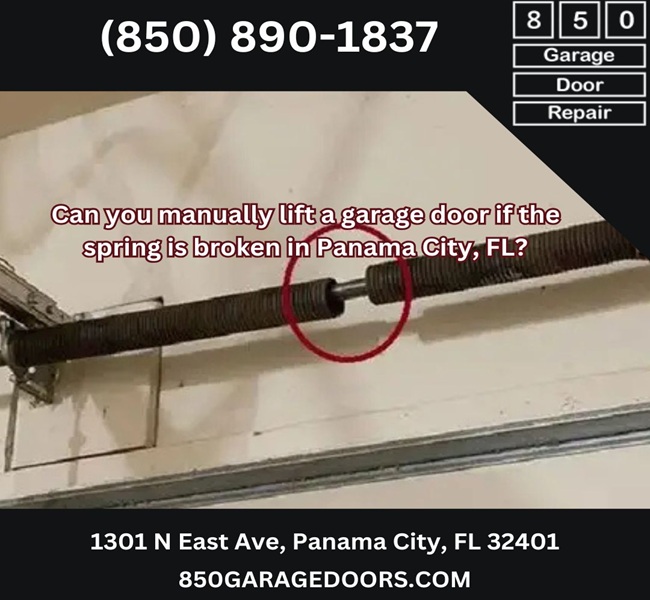
Torsion springs run horizontally above the door opening along a metal shaft. If you look up at the spring and see a visible gap or separation anywhere along its coil, the spring has broken. Extension springs run along the horizontal tracks on either side of the door. A broken extension spring will often be visibly slack, hanging loose, or separated entirely from its mounting hardware.
Other signs to look for include:
- The door opens only a few inches and then stops even with the opener running
- One side of the door appears lower than the other when viewed from the front
- The opener sounds like it is straining or running louder than normal
- The door feels extremely heavy when you attempt to move it manually
- Visible fraying or displacement of the lift cables on either side of the door
Why Panama City's Salt Air and Humidity Accelerate Spring Failure
Panama City sits along the Gulf Coast, and that coastal environment creates conditions that are genuinely harder on garage door hardware than most inland areas experience. Salt air is corrosive. It works into the metal coils of a torsion or extension spring over time, weakening the material and reducing the number of cycles the spring can handle before breaking. High humidity compounds this by preventing metal surfaces from fully drying after exposure to moisture.
A spring rated for 10,000 cycles under normal conditions may fail significantly earlier in a Panama City home that is not properly maintained. Homeowners who skip annual lubrication and inspection are giving that corrosion a head start every season. Hurricane season adds another layer of concern. Rapid pressure changes, driving rain, and the debris that comes with major storms all contribute to accelerated wear on components that are already dealing with a tough coastal climate year round.
The One Sound That Tells You the Spring Already Snapped
Many homeowners in Panama City discover their spring is broken not by sight but by sound. A torsion spring that snaps under load produces a loud bang that can sound like a gunshot inside a closed garage. If you heard that sound and your door stopped working shortly after, the spring is almost certainly the cause. Do not attempt to operate the door manually or with the opener until a certified Broken Garage Door Spring Repair has been completed by a qualified technician.
The Real Dangers of Manually Lifting a Door With a Broken Spring
Even if lifting the door seems possible in the moment, the act of doing so creates risks that extend well beyond the initial attempt. The dangers are not limited to the person lifting. They extend to the entire door system and anything or anyone nearby.
Risk of Sudden Door Drop and Physical Injury
Without spring tension, a garage door has no passive hold at any open position. A standard door held open by hands or propped in place is relying entirely on whatever is physically supporting it at that moment. If that support fails even briefly, the door falls. A 150 pound steel door falling from a partially open position generates enough force to cause serious injury or worse. The tracks provide no braking mechanism. The door simply drops until it hits an obstacle or the ground.
This risk is especially high for homeowners who try to prop the door open with an object and then work underneath it or use the opening to move a vehicle. That is one of the most dangerous positions to be in when a door loses its support.
How a Manual Lift Can Damage Cables, Drums, and Tracks
The cables that connect your door to the spring system are designed to work within a specific range of tension and movement. When the spring is broken and you attempt to manually lift the door, those cables lose their alignment. They can slip off the drums at the top of the door, kink under uneven load, or snap entirely if the lift is uneven. Replacing cables, drums, and tracks adds significantly to the scope of a repair that could have been limited to just the spring itself had the door not been forced open.
Track damage is another common result. Lifting a heavy door without proper spring counterbalance puts lateral stress on the track system. Bent or misaligned tracks and worn components needing Garage Door Rollers Repair can prevent the door from operating correctly even after the spring is replaced, creating additional repair work that was entirely avoidable.
What Happens to Your Opener When Forced to Work Without Spring Support
Garage Door Openers are engineered to move a balanced door. They are not designed to lift the full unassisted weight of a residential garage door. When a broken spring leaves the door without counterbalance and the opener is activated anyway, the motor is working far outside its intended load range. This can burn out the motor, strip the drive gear, or trigger the auto reverse safety sensor in ways that leave the door stuck partway open or closed.
Opener repairs and replacements are an added expense that is entirely avoidable by simply not operating the door on a broken spring.
Using the Emergency Release Cord the Right Way vs. the Wrong Way
Most garage doors have a red emergency release cord hanging from the opener trolley. Many homeowners assume that pulling this cord gives them a safe way to manually operate the door if the opener fails or if the power goes out. That assumption is only partially correct, and it becomes actively wrong when a broken spring is involved.
When the Red Cord Is Safe to Pull and When It Is Not
The emergency release cord disconnects the door from the opener trolley so the door can move freely on its own. In a normal situation, with both springs intact, the door remains balanced after disconnection and can be lifted and lowered by hand with manageable effort. This is the scenario the cord was designed for.
When a spring is broken, pulling the emergency release cord does not fix or compensate for the missing counterbalance. It simply removes the opener from the equation. You are then left with a fully disconnected, fully unbalanced door carrying its complete weight with nothing to assist movement in either direction. In that condition, the door can fall rapidly if partially open, and lifting it from the closed position requires enough force that most people cannot sustain the hold needed to prevent a drop.
Why Disconnecting the Opener Does Not Solve the Weight Problem
A common misconception is that the opener itself is what makes the door feel stuck when the spring is broken. In reality, most openers have built in resistance limits that cause them to stop when the load exceeds a safe threshold. That stopping is a protection feature. Bypassing the opener by pulling the release cord removes that protection without resolving the underlying problem. The door is still broken. It is just also now free to move without any electronic safety controls in place.
What Panama City Homeowners Should Do When the Spring Breaks
The safest and most cost effective response to a broken garage door spring is to leave the door in its current position and call a professional repair service. Attempting to force a resolution on your own almost always adds to the total repair scope rather than reducing it.
Temporary Steps to Secure the Door While You Wait for Repair
If the door is currently in the closed position when the spring breaks, leave it closed. A closed door in that state is stable and is not posing an immediate safety risk. Do not attempt to open it to access your vehicle or the garage interior until the spring has been replaced by a qualified technician.
If the door is partially open when the spring breaks, do not attempt to close it manually. Contact a repair professional and describe the situation. They can advise on whether the door needs to be secured in place before they arrive. Under no circumstances should anyone stand or work beneath a partially open door that is not properly supported.
Why Spring Repair Is Not a DIY Fix in Florida's Coastal Climate
Torsion springs operate under extreme tension. A single torsion spring on a residential door can hold hundreds of pounds of stored mechanical energy. Removing or installing a spring without the proper tools and training is genuinely dangerous. The spring can release suddenly if handled incorrectly, with enough force to cause severe injury.
In a coastal environment like Panama City, the added factor of corrosion means that hardware does not always behave predictably. A spring that looks intact may have hidden structural weakness from salt air exposure. A cable that seems fine may be close to its failure point. A trained technician knows how to evaluate the full system, not just the component that visibly failed.
| Situation | Recommended Action |
|---|---|
| Door is closed and spring is broken | Leave the door closed and call a professional immediately |
| Door is partially open with a broken spring | Do not move the door and keep the area clear until a technician arrives |
| Opener is running but door is not moving | Disconnect power to the opener and avoid further operation |
| Emergency release cord has been pulled | Do not attempt to manually lift the door without spring support in place |
| Visible gap or break in the spring coil | Treat the door as unsafe to operate and schedule same-day repair service |
Get Your Broken Spring Fixed Fast in Panama City, FL
A broken garage door spring is one of the most common service calls in Panama City, and for good reason. The combination of heat, humidity, salt air, and the mechanical stress of daily use means springs in this region wear faster than in drier, more temperate climates. The good news is that spring replacement is a repair with a clear solution when handled by an experienced technician with the right tools.
The risk is in the delay and in the attempt to work around the problem rather than fix it. Every time someone forces a broken spring door open or tries to keep using it through the opener, the potential repair scope grows. What starts as a single spring replacement can become a cable replacement, a drum realignment, an opener repair, or all of the above.
If you are in Panama City and dealing with a garage door that is not moving the way it should, trust the signs you are seeing. A heavy door, a loud snap, a gap in the spring coil, or an opener that sounds like it is working too hard are all telling you the same thing. Stop operating the door and get a professional on site before the problem compounds.
Conclusion
So, can you manually lift a garage door if the spring is broken in Panama City, FL? Technically yes. Safely, no. The spring is not a secondary component. It is the part of the system that makes safe door operation possible in the first place. Without it, the door becomes a heavy, unbalanced hazard that can injure people, damage property, and turn a straightforward repair into a much more expensive one.
Panama City homeowners face real environmental pressures that make spring failures more common and more unpredictable than in other parts of the country. The coastal climate demands more from hardware and less forgiveness when maintenance is deferred. When a spring fails, the right response is not to push through it but to call in a professional who understands both the mechanics and the local conditions.
850 Garage Doors serves Panama City and the surrounding Florida Panhandle with experienced technicians who handle broken spring repairs, Garage Door Opener Replacement, and related services the right way. If your door is showing any of the warning signs covered in this post, visit 850garagedoors.com or call the team today to schedule a service appointment before the situation gets worse.